
The Hine’s Emerald Dragonfly is a unique dragonfly with a wingspan around 3.5” and almost bronze coloring with bright green eyes and a white stripe that develops when dragonflies reach maturity.
The life cycle of this dragonfly presents challenges that differentiate this species from other dragonflies.
The larvae of the Hine’s Emerald do not reach maturity for five years. During this time, the dragonflies’ larvae live in wetland habitats.
During the winter months, they lay dormant inside of crayfish burrows, which is a natural predator of the larvae of this species.
Adults live through early spring through summer, around a total of eight weeks, in which they eat a variety of species including salamanders, amphibians, and small fish.
They utilize both wetlands and marshy areas as habitats in this life phase, making many habitats critical for their survival.

The Hine’s Emerald Dragonfly is an Endangered Species to date, both globally, federally in the United States, and locally in my home state of Michigan.
Groundwater contamination, habitat loss, and scattered populations limiting successful breeding due to the habitat fragmentation are all threats to this species.
Contamination of groundwater from human activities, including agricultural land use and the application of pesticides, is a huge issue.
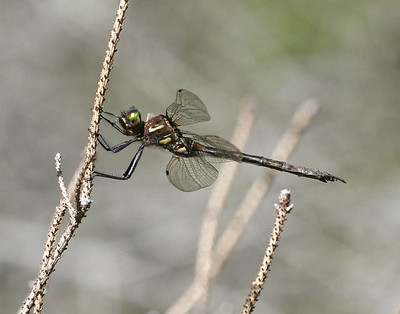
Conservation work is being done to help restore this species population to stable numbers again, but these efforts have a long way to go before it is safe to say the Hine’s Emerald Dragonfly will not become extinct.
The species native habitat range includes the states of Michigan, Wisconsin, Illinois, Missouri, Ohio, and Indiana.
This species does not migrate, so all efforts are being made for their survival in the states they still remain in, with the populations in Ohio and Indiana already reaching full extinction.
Nature preserves are the biggest effort in restoring populations to healthy numbers, and several are established in areas where there are documented populations of this species,
with the immediate challenge of these preserves abutting industrial properties, which are imperiling these efforts with groundwater contamination.
Further, there is legislation that is constantly being challenged. This legislation is intended to protect species and ensure overdevelopment does not cause excessive fragmentation of critical habitats that these dragonflies depend on.
More efforts are necessary to ensure this species, and many others, have enough habitat range to continue to thrive.